How we work
We work below the surface, where performance grows.
Most programs treat what is visible. We work on what keeps the room from saying what it sees, and we measure what changes.

What you see
Above the surface
- Decisions that take longer than they should
- Agreement in the room, the real conversation at the coffee machine
- Risks that reach the top too late
- Energy and execution that slowly drain away
What we work on
Below the surface
- Fear and silence in the team
- The elephants nobody names
- Misalignment the top cannot see
- Trust that has fractured and not been repaired
- How each leader reacts when the truth arrives
Most programs work on the small part above the line. What lasts grows underneath.
Our model: how truth travels
Truth reaches the decision only if it passes three gates.
By truth we mean what people actually see: risks, mistakes, disagreement, better ideas. Under pressure, each gate narrows. It starts with the leader, because how you react decides whether anyone tries again. And every time the system acts, the next truth travels faster.
Safety to speak, and standards to act.
The leader holds it.
When bad news arrives, the leader's reaction decides whether the next bad news ever comes. That is where the power lies. Space of Choice™ trains that moment.
Coaching for leadersThe team says it.
Psychological safety. “Just speak up” fails where speaking up is risky, so we change what makes it risky. Then people name what they see, including the elephants, and the team works with it.
For executive teamsThe system acts on it.
Speaking up takes courage, and courage needs a response. What the organization acknowledges, reinforces and acts on, in its decisions, responsibilities, accountabilities and feedback routines, decides whether candor survives the meeting.
For organizations and boardsGate 01 in depth · the leader model
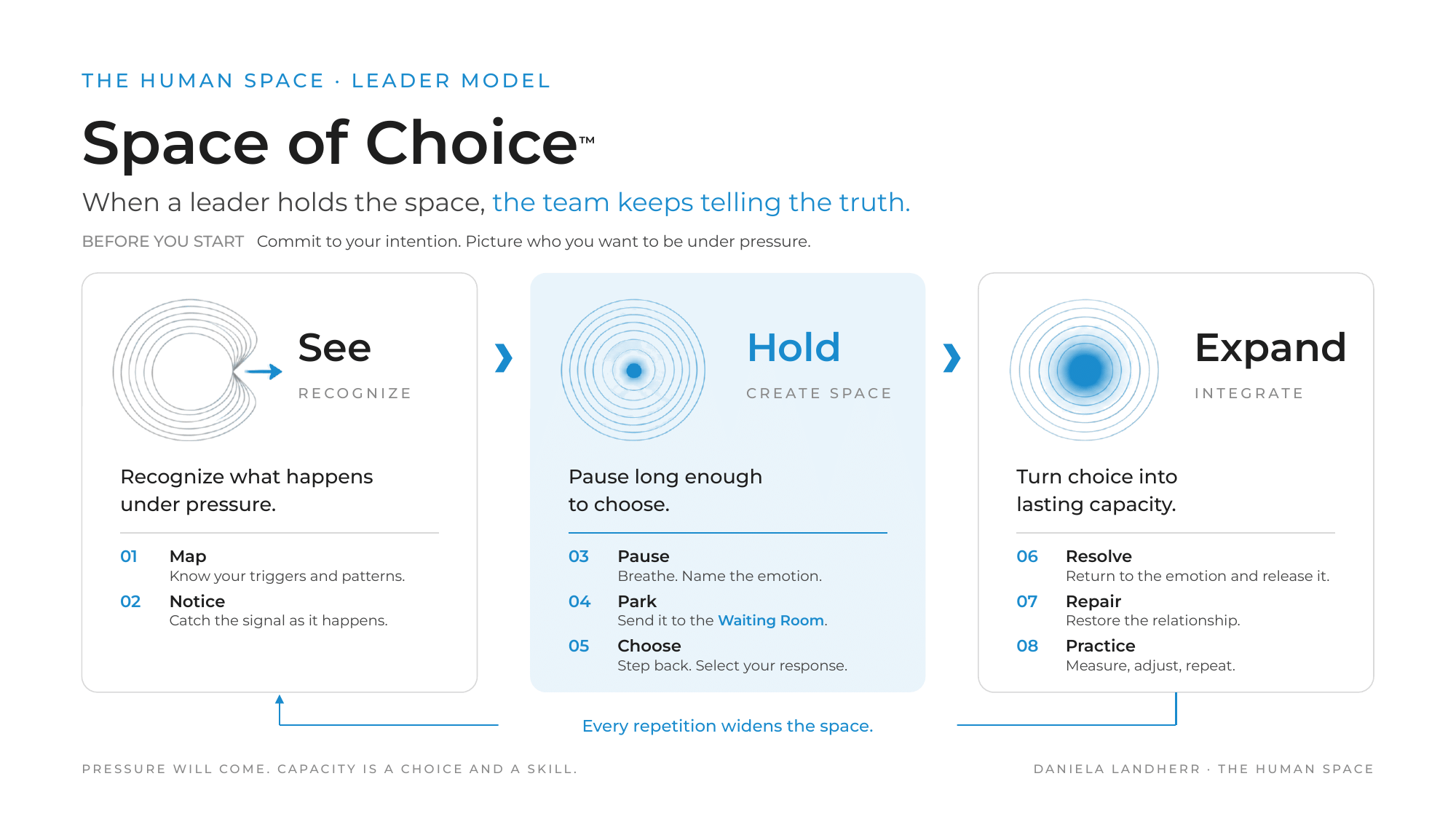
Space of Choice™
Every leader gets triggered. What happens next decides whether truth can reach them, and whether psychological safety survives in their team. The space between trigger and response is not a new idea. Holding it under pressure is a skill, and we train it: See, Hold, Expand, with the Waiting Room for the moment itself.
Psychological safety out of 10, the team’s own rating
A global HR team, morning to evening of its first full day together. Read the case
The work, step by step
Diagnose. Work with the team. Embed. Measure.

- 01
Diagnose
Confidential interviews, shadowing in real meetings and a baseline survey show what the room is not saying, and why. - 02
Work with the team
Offsites, team sessions and individual coaching over months, in phases with a decision point after each. - 03
Embed
New habits become routines: upward feedback on the behaviors leaders chose, decision forums, feedback rituals and train-the-trainer for HR, so the change does not depend on us. - 04
Measure
The same measures before and after, so the CEO and the board see what moved.
In and on the system
People change in a room. The system decides whether it lasts.
Coaching and offsites change how people show up. If the organization still rewards agreement over truth, the old pattern returns within weeks. So we also work on the system itself: what it acknowledges, what it reinforces and what it acts on.
Leaders choose what they want to be measured on
The leadership group defines the few behaviors that matter, in its own words. Owned, not imposed.
Teams rate their leaders on those behaviors
Every leader gets a confidential report and a plan, and the round repeats, so progress is visible and leaders are accountable for it.
The conversations become habits
Training for managers in the hard conversations, feedback rituals and culture labs where employees help shape the change.
Ask me anything
The questions people only ask each other, asked out loud.
Small sessions, up to 16 people. Leaders answer the real questions, prepared for the trigger, not scripted.
How it worksClose
The CEO goes first, then other leaders take turns, and some open their own sessions people sign up for. Questions come in anonymously beforehand and live in the room.
Prepared for the trigger, not scripted. We don’t write the answers. With Space of Choice™, we prepare each leader for the questions likely to trigger them, so they answer honestly, without dodging or softening.
A mediator when it’s delicate. We anticipate the hardest questions with the team beforehand, and when a question feels too risky to ask out loud, Daniela asks it.
What happened at one firm
The night before the session, someone quietly left an anonymous list of questions on HR’s desk, hoping it would reach Daniela. We read it as a signal: these were the things nobody felt safe to ask out loud. Daniela put them to leadership in the session. It opened up a great deal.
Psychological safety among 14 themes in a firm-wide survey, one year apart
A European investment firm, about 100 people. Read the case
What we draw on
Five disciplines, one practice.
Systems-psychodynamic approach
The conscious and unconscious dynamics in a leadership system: anxieties, power, roles, avoidance, blame loops.
Cognitive behavioral coaching
Trigger awareness, reframing, emotional regulation and difficult conversations for individual leaders.
Psychological safety and trust science
Amy Edmondson's research, Google’s published research on effective teams and managers (Project Aristotle and Project Oxygen), and what Daniela learned in 15 years at Google, coaching leaders of large Google organizations and applying it in her own organization of 120 people: premortems, team norming, mindset shifts. The Human Space is not affiliated with Google.
Behavioral systems design
Insight turned into routines: rituals, decision forums, feedback systems, culture labs.
Data-driven diagnostics
Interview coding, the Psychological Safety Index, pulse surveys and trust trends over the whole journey.
What we measure
Psychological safety · trust in leadership · alignment and execution · energy and productivity · engagement
What clients get
Leaders who hear the truth earlier, and teams that act on it.
Faster decisions, fewer surprises at the top, and measured gains in trust and psychological safety. Read the results, or see where we work.